

Penile Curvature & Peyronie's Disease Treatment Seomyeon Busan | Urogyn
📍

Seomyeon, Busan

5 min · Seomyeon Station Exit 5

🩺

Board-Certified Urologist

Specialist Men's Clinic

30 min – 1 hour Surgery

Local + IV Sedation

🌐

English Consultations

International Patients Welcome

Urogyn Men's Clinic · Seomyeon, Busan

Penile Curvature
& Peyronie's
Treatment in Busan

📍 Seomyeon, Busanjin-gu, Busan  |  🚇 Seomyeon Station Exit 5  |  🌐 English OK  |  🔒 Confidential

Specialist surgical correction of penile curvature (음경만곡증) and Peyronie's disease at Urogyn Men's Clinic in Seomyeon, Busan. Two proven surgical techniques — tunica plication (백막중첩술) for standard curvature and tunica incision with grafting (백막절개+이식술) for length-preserving correction of severe curvature. Artificial erection assessment confirms correction intraoperatively. Board-certified urologist. English consultations.

Quick Answer

Penile curvature correction at Urogyn Seomyeon, Busan2 surgical options: (1) Tunica plication for standard cases, (2) Tunica incision + grafting for length-preserving severe-curvature correction. 30 min–1 hour procedure. 2-day return to work. 4-week sexual abstinence. English OK.

At a Glance
Location Seomyeon, Busan
Surgical options 2 techniques
Threshold >30° or pain
Procedure 30 min – 1 hr
Anaesthesia Local + IV
Return to work 2 days
Abstinence 4 weeks
Language English OK
Book via WhatsApp

Confidential · International patients welcome

Part 1 · Understanding

What Is Penile Curvature?

Penile curvature (음경만곡증) is an abnormal bending of the penis during erection — most commonly bending upward, downward, or sideways — that can cause pain, sexual difficulty, or psychological distress. Curvature exists on a spectrum: minor deviation (under 30 degrees) is very common and typically causes no problems; significant curvature (over 30 degrees) or any curvature causing functional issues is medically significant and correctable through modern surgical techniques.

The penis is straightened during erection by the tunica albuginea — a strong, elastic sheath surrounding the two corpora cavernosa (the erectile chambers). When this tunica is symmetric and healthy, erection produces a straight penis. When one side is shorter, thicker, or less elastic than the other — either from birth or from acquired fibrous plaque — the penis bends toward the shorter/stiffer side during erection. Both congenital curvature and Peyronie's disease ultimately cause curvature through the same mechanism: asymmetric tunica function.

Two Main Causes of Penile Curvature

Congenital penile curvature asymmetric tunica from birth
Cause 01 · Congenital
Congenital Curvature

Asymmetric tunica albuginea development present from birth. Evident from the first adult erections — the curvature has always existed and is typically stable (not progressive). Most common in men in their 20s-30s presenting because the curvature is now causing sexual difficulty or is perceived as aesthetically problematic. Does not involve any plaque or scar tissue.

Peyronie's disease acquired curvature from plaque formation
Cause 02 · Acquired (Peyronie's)
Peyronie's Disease

Acquired curvature from fibrous plaque formation in the tunica — most commonly after micro-trauma during intercourse, occasionally from significant injury, and sometimes spontaneously. Plaques typically develop over 6-18 months before stabilising. Most common over age 40. The plaque prevents normal expansion on its side during erection, causing the penis to bend toward the affected side.

⚠ When to Seek Evaluation

  • Curvature greater than 30 degrees during erection
  • Pain during erection (indicates active plaque)
  • Palpable hardness or lump on the penile shaft
  • Difficulty with or inability to have intercourse
  • Curvature worsening progressively over months
  • Associated erectile difficulty or dysfunction
  • New development of bend that was not present before
  • Psychological distress or relationship impact
Part 2 · When Is Surgery Indicated?

Surgical Indications

Not all curvature requires surgery. Mild curvature without functional problems is typically managed conservatively. Surgical correction is indicated when curvature causes measurable functional or psychological impact. The two primary indications are objective curvature severity and subjective functional impact.

Penile curvature greater than 30 degrees threshold
Indication 01
Curvature > 30 Degrees

Curvature of 30 degrees or greater, measured during standardised erection assessment, is the clinical threshold for surgical consideration. Below this, most men can have satisfactory intercourse despite the bend. Above this, mechanical penetration difficulty becomes common and progressive worsening is more likely.

Penile curvature causing intercourse pain or difficulty
Indication 02
Functional Impact

Any curvature causing pain during erection, difficulty achieving penetration, inability to have intercourse, or significant psychological distress is surgically treatable regardless of absolute angle. A 25-degree curve with severe functional impact may require treatment while a stable 35-degree curve without symptoms may not.

Consequences of Leaving Significant Curvature Untreated

  • Progressive erectile dysfunction — curvature can interfere with blood flow dynamics over time
  • Increased intercourse difficulty — worsening penetration problems as curvature progresses
  • Partner injury risk — severely curved penis can cause vaginal discomfort or injury
  • Relationship impact — untreated curvature commonly affects intimacy and partner satisfaction
  • Psychological distress — loss of confidence, avoidance behaviour, depression
  • Pain chronicity — erection pain from Peyronie's can persist if untreated
Part 3 · Surgical Techniques

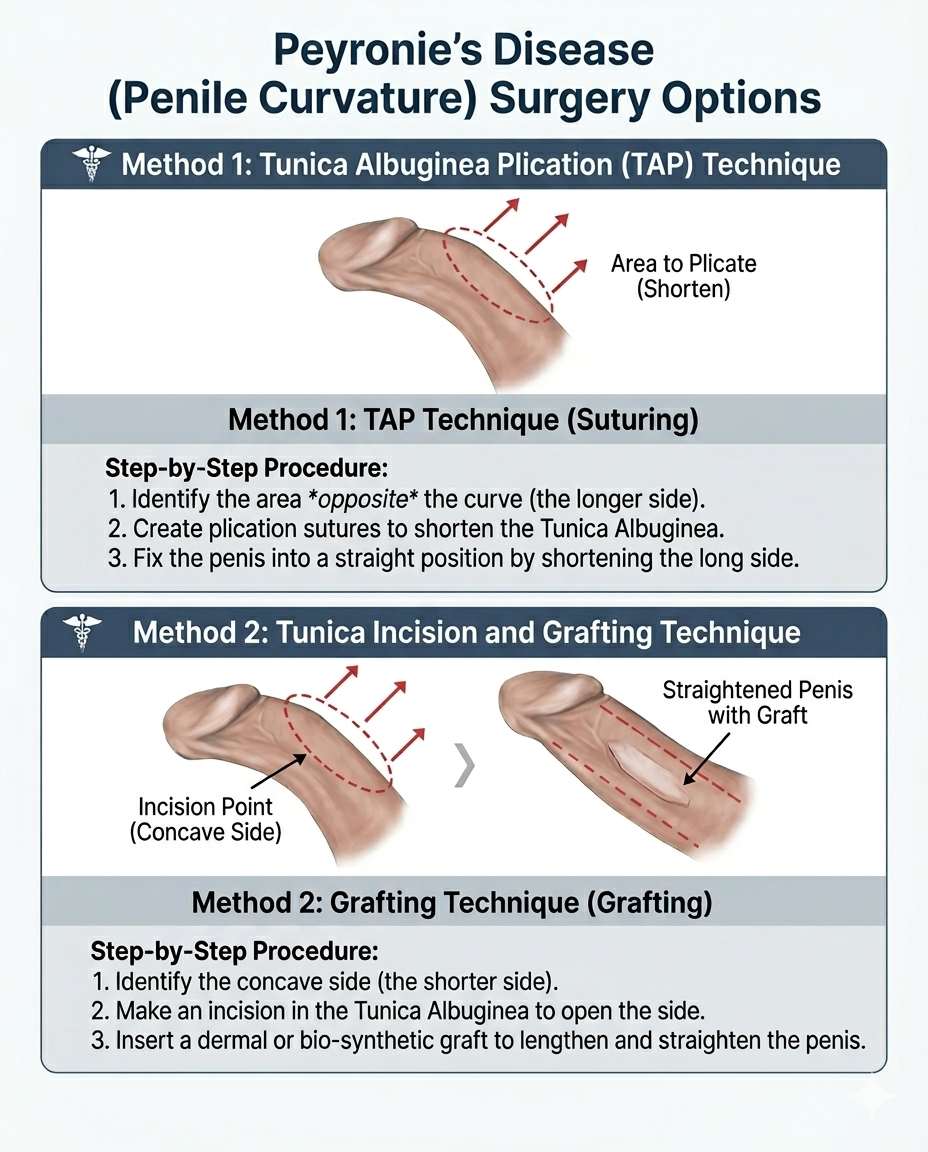
2 Surgical Correction Options

Urogyn Busan offers two established surgical techniques for penile curvature correction, selected based on your curvature severity, pre-existing length, erectile function, and preferences. Both are performed under local anaesthesia with IV sedation, take 30 minutes to 1 hour, and allow return to desk work within 2 days.

Tunica plication technique for penile curvature correction
Option 01 · Standard
Tunica Plication
— 백막중첩술 (Plication / Nesbit-Yachia)

The standard and most widely used correction technique. Non-absorbable sutures are placed on the longer (convex) side of the tunica albuginea, shortening that side to match the shorter side — resulting in a straight erection. No incision of the tunica is made; nothing is removed or grafted.

1
Artificial erection induced to confirm exact curvature angle and direction
2
Plication sutures placed on the convex (longer) side of the tunica
3
Second intraoperative erection confirms straight correction
  • Best for: standard curvature, adequate pre-op length
  • Procedure time: 30-45 min
  • Length impact: 0.5-1cm shortening (expected)
  • Complexity: standard, highly reliable
  • Recovery: 2 days to desk work, 4 weeks abstinence

How Technique Is Selected

At consultation, the urologist discusses the following factors to help you choose the optimal technique:

  • Curvature severity — plication works well up to about 60 degrees; beyond that, grafting is preferred
  • Pre-operative length — men with shorter baseline length benefit from length-preserving grafting
  • Erectile function — both techniques require adequate baseline erectile function; severe coexisting ED may alter the plan
  • Peyronie's vs congenital — Peyronie's with extensive plaque may require grafting; congenital curvature typically suits plication well
  • Patient preference — simplicity and reliability (plication) vs length preservation (grafting) are the main trade-offs
Quick Facts

At-a-Glance Q&A

Q 01
Surgery Time

Plication 30-45 min
Grafting 45-60 min

Q 02
Recovery Period

About 2 days
to desk work

Q 03
Sexual Activity

Abstain 2-3 weeks
fully resume 4 weeks

Q 04
Length Change

Slight shortening possible
(offset by correction)

Q 05
Follow-Up

3-5 days suture check
2-3 weeks review

Clinical Quality System

Urogyn's 7-Point Care Standard

01
Objective Angle Measurement

Standardised photography and physical examination quantifies curvature before surgical planning.

02
Erectile Function Assessment

IIEF-5 and vascular assessment screens for coexisting ED that could affect surgical outcome.

03
Plaque Mapping

For Peyronie's disease, ultrasound maps plaque size and location to guide surgical planning.

04
Stability Confirmation

Peyronie's patients assessed for 6-12 month plaque stability before elective surgery.

05
Artificial Erection Test

Intraoperative saline-induced erection confirms both curvature and post-correction straightening.

06
Individualised Technique

Plication vs grafting selection based on severity, length, and patient preference.

07
Structured Follow-Up

3-5 day suture check, 2-3 week review, 3-month final assessment with photo documentation.

+
International Patient Support

English records, photo review, and WhatsApp follow-up after you return home.

Confidentiality & Candidates

Privacy & Suitability Assessment

Independent Consultation Room

Fully private consultation rooms — comfortable discussion of sensitive concerns.

Separate Patient Records

Isolated records system. No cross-department data sharing.

1:1 Care System at Urogyn Busan
1:1 Care System

Dedicated staff from check-in to discharge. Zero exposure.

✓ Good Candidates

  • Curvature over 30 degrees confirmed by standardised measurement
  • Pain during erection or intercourse difficulty from curvature
  • Stable Peyronie's disease (at least 6-12 months from plaque onset)
  • Congenital curvature present from first erections
  • Adequate erectile function to support surgical correction
  • Partner difficulty or psychological distress from curvature
  • International patients seeking specialist English-speaking care

⚠ Important Considerations

  • Mild curvature under 30 degrees without functional issues — observation preferred
  • Active Peyronie's phase (under 6 months, progressing plaque) — wait for stability
  • Severe coexisting erectile dysfunction — combined planning required
  • Unrealistic expectations of perfect post-surgical appearance — some residual may remain
  • Plication patients must accept small length reduction trade-off
  • Grafting patients require longer recovery and stricter post-op restrictions
FAQ

Frequently Asked Questions

Common questions from international patients considering penile curvature correction in Busan, Korea.

What is penile curvature?
Penile curvature (음경만곡증) is abnormal bending of the penis during erection. Curvature can be congenital — present from birth due to asymmetric tunica albuginea development — or acquired through Peyronie's disease, which involves fibrous plaque formation in the tunica after trauma, repetitive microinjury, or spontaneously in middle-aged men. Mild curvature under 30 degrees is common and usually not problematic. Curvature over 30 degrees, or any curvature causing pain, sexual difficulty, or psychological distress, is medically significant and treatable.
What causes penile curvature?
Two main categories: (1) Congenital curvature — asymmetric development of the tunica albuginea (the elastic sheath that contains the corpora cavernosa), present from birth and evident from first adult erections; (2) Peyronie's disease (acquired) — fibrous plaque formation in the tunica, typically from micro-trauma during intercourse, rarely from significant injury, or spontaneously. Peyronie's disease is much more common over age 40. The plaque is inelastic scar tissue that prevents that side of the tunica from expanding during erection, causing the penis to bend toward the affected side.
When does penile curvature need treatment?
Indications for treatment include: (1) Curvature over 30 degrees measured by standardised assessment; (2) Pain during erection; (3) Difficulty with or inability to have penetrative intercourse; (4) Significant psychological distress or relationship impact; (5) Peyronie's disease in the stable phase (6-12 months after plaque stabilises). Mild curvature without functional problems usually does not require surgery. The decision to treat is highly individualised and discussed in detail at consultation.
What are the surgical options at Urogyn Busan?
Two main surgical techniques: (1) Tunica plication (백막중첩술) — sutures are placed on the longer convex side of the tunica to shorten that side and straighten the penis. Simple and reliable but causes some loss of length (typically 0.5-1cm); best for shorter curvatures and adequate pre-operative length. (2) Tunica incision + grafting (백막절개+이식술) — the shortened concave side is incised to release the curvature, and the defect is covered with a graft (dermal matrix or autologous tissue). Preserves length but is more complex; best for severe curvature, pre-existing shorter length, or Peyronie's with tissue loss.
Will surgery make my penis shorter?
It depends on the technique. Tunica plication inherently shortens the longer side, typically resulting in 0.5-1cm length reduction — this is an expected trade-off for straightening. Tunica incision with grafting is specifically designed to preserve length; the shortened concave side is lengthened via graft to match the convex side. The urologist discusses expected length impact at consultation and helps you weigh technique selection. For patients prioritising length preservation, grafting is preferred despite its greater complexity.
How long is recovery after curvature surgery?
Recovery timeline: return to desk work at 2 days; moderate physical activity at 1 week; morning erections may be uncomfortable for 3-5 days (normal); complete tissue healing at 6-8 weeks. Sexual activity must be avoided for 4 weeks to protect the suture or graft. Follow-up visits at 1 week and 1 month assess healing and straightening. Most patients resume normal daily activity quickly, with the main restriction being the 4-week sexual abstinence period.
What happens if curvature is left untreated?
Untreated significant curvature can lead to: (1) Progressive difficulty or inability to have intercourse; (2) Pain during erection persisting long-term; (3) Erectile dysfunction as the curvature worsens and affects blood flow; (4) Penetration injury risk to partner; (5) Decreased self-confidence and relationship impact; (6) For Peyronie's disease specifically, the plaque can progress over 12-18 months before stabilising — sometimes worsening curvature during that time. Early specialist assessment allows monitoring of progression and timely intervention when indicated.
Can Peyronie's disease be treated without surgery?
Some non-surgical options exist for mild or active-phase Peyronie's disease: oral medications (pentoxifylline, coenzyme Q10, vitamin E — limited evidence), intralesional injections (collagenase/Xiaflex where available, verapamil), traction therapy devices, and shockwave therapy. These approaches are most useful during the active (inflammatory) phase of Peyronie's when the plaque is still forming. Once the plaque stabilises (usually 6-12 months), surgical correction is the definitive treatment for functionally significant curvature. Mild Peyronie's without functional impact often does not require any treatment.

Book Your Curvature
Consultation Today — English OK

Board-certified urologist in Seomyeon, Busan. 2 surgical techniques. Objective angle measurement. Private & confidential.

📍 Seomyeon, Busanjin-gu, Busan 🚇 Seomyeon Station Exit 5 — 5 min walk 🔒 Strictly Confidential 🌐 English · 한국어