
Progator Prostate Ligation Seomyeon Busan | Minimally Invasive BPH | Urogyn
📍

Seomyeon, Busan

5 min · Seomyeon Station Exit 5

🩺

Board-Certified Urologist

Minimally Invasive Specialist

🌐

English Consultations

International Patients Welcome

Same-Day Procedure

15-30 min · Local Anaesthesia

Urogyn Men's Clinic · Seomyeon, Busan

Progator
Prostate Ligation
in Seomyeon, Busan

📍 Seomyeon, Busanjin-gu, Busan  |  🚇 Seomyeon Station Exit 5  |  🌐 English OK  |  ⚡ Local Anaesthesia Only

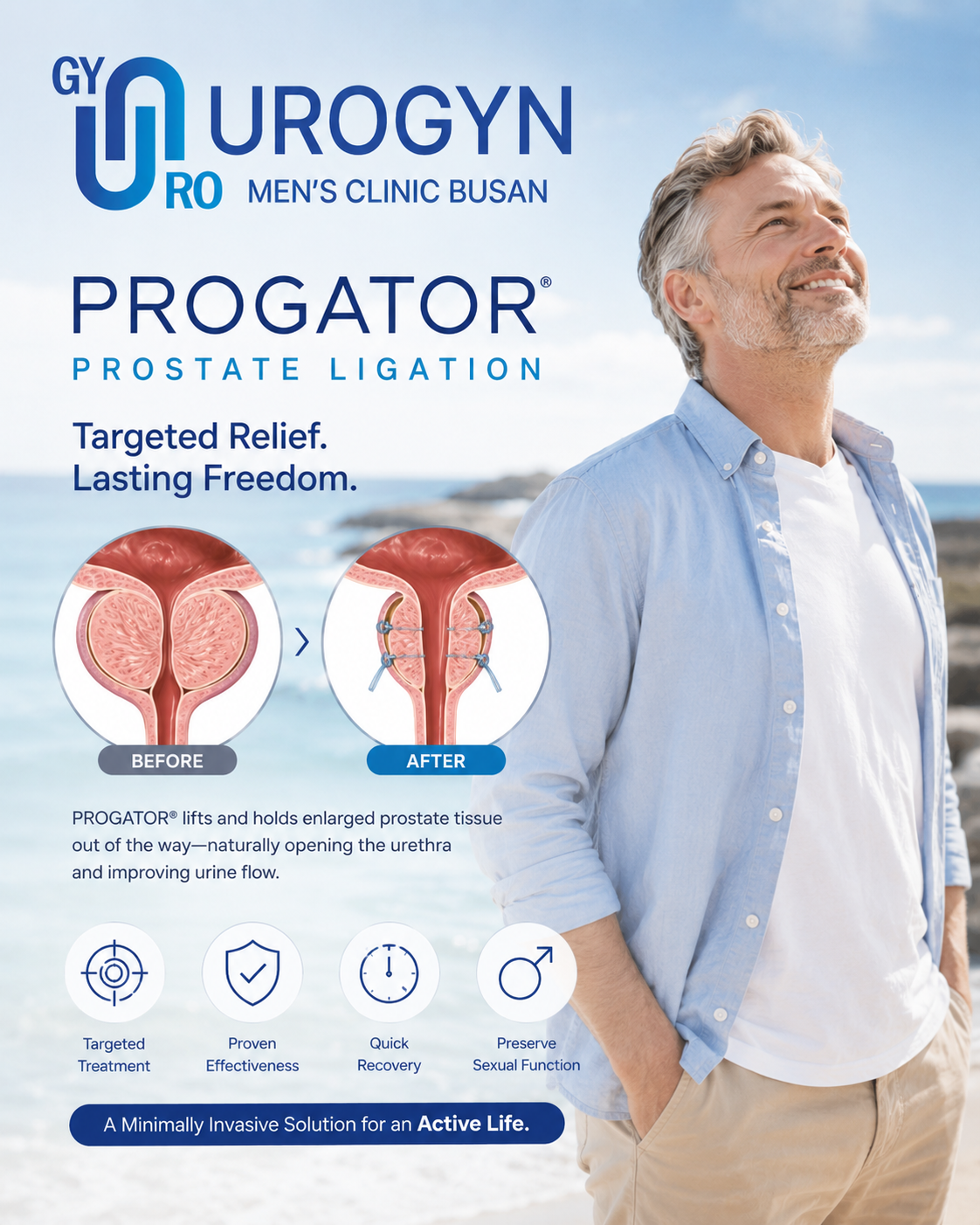
Progator (전립선결찰술) is a minimally invasive BPH treatment performed at Urogyn Men's Clinic in Seomyeon, Busan — small permanent implants physically retract enlarged prostate tissue without cutting, removing, or burning any tissue. No general anaesthesia. 15-30 minute procedure. Return to normal activity within 1-2 days. Preserves sexual function (99% antegrade ejaculation rate). English consultations.

Quick Answer

Progator at Urogyn Seomyeon, Busan — minimally invasive BPH treatment using implants instead of tissue removal. 15-30 min local anaesthesia. 1-2 day recovery. Preserves ejaculation 99%. Ideal for moderate BPH (30-80mL prostate) wanting to avoid TURP, Rezum, or long-term medication. English OK.

At a Glance
Location Seomyeon, Busan
Procedure 15–30 min
Anaesthesia Local only
Tissue removal None
Recovery 1–2 days
Sexual fn. Preserved 99%
Symptom relief 2–4 weeks
Book via WhatsApp

Confidential · International patients welcome

About the Procedure

What Is Progator Prostate Ligation?

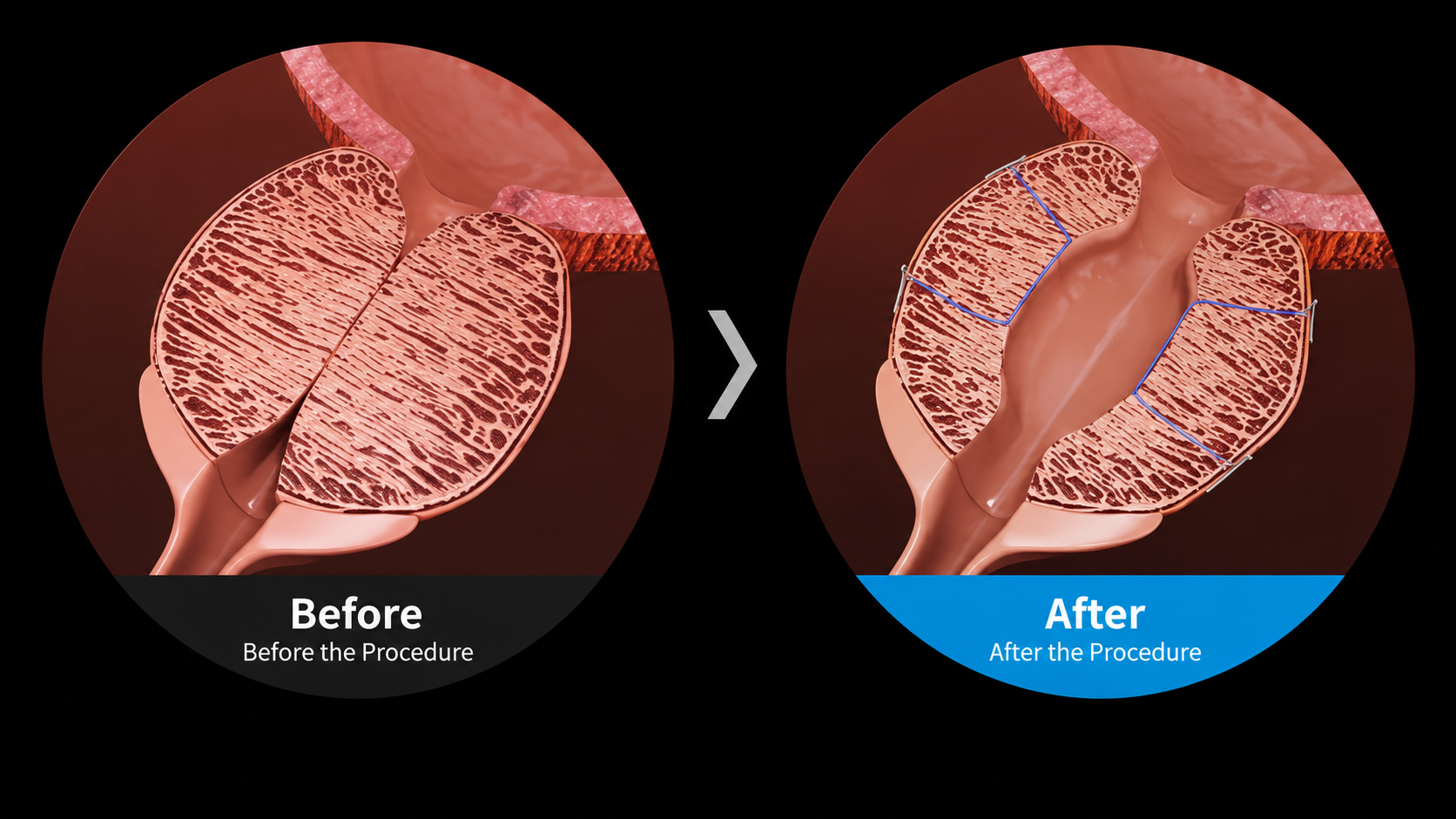
Progator before and after - enlarged prostate vs opened urethra after ligation

Before Progator (left): compressed urethra due to enlarged prostate. After Progator (right): implants retract prostate tissue, opening the urethral passageway.

Progator (전립선결찰술 — prostatic urethral lift / prostate ligation) is a tissue-sparing minimally invasive treatment for BPH (benign prostatic hyperplasia / enlarged prostate). Unlike traditional surgical approaches that cut, burn, or remove prostate tissue, Progator works through a fundamentally different mechanism: small permanent implants are precisely placed through the prostate lobes to mechanically pull back the tissue compressing the urethra. The prostate itself remains intact but is physically "held open," immediately relieving urinary obstruction.

The procedure belongs to the category of prostatic urethral lift (PUL) technologies — the same mechanistic class as UroLift. It represents a significant clinical advance because it addresses one of the oldest problems in BPH surgery: the trade-off between effective treatment and side effects. Traditional TURP surgery is highly effective at relieving BPH but causes retrograde ejaculation in 50-75% of patients and requires substantial recovery. Progator, by preserving all prostate tissue and avoiding electrocautery, maintains antegrade ejaculation in approximately 99% of patients — a dramatic improvement especially valued by sexually active men.

The Mechanism: Ligation, Not Removal

The word "ligation" (결찰) is key to understanding how Progator works. Ligation means tying, binding, or securing — in this case, securing the enlarged prostate tissue in a retracted position using small permanent implants. Each implant consists of an anchor placed in the outer prostate capsule, a tether, and a clip — positioned through a small needle passed via the urethra under cystoscopic visualisation. When the implant is deployed, it physically compresses the lateral prostate lobes outward, opening the prostatic urethra. Multiple implants (typically 4-6) are placed to achieve the desired degree of channel opening.

Why Choose Progator Over Other BPH Treatments?

Progator occupies a unique position in the BPH treatment landscape. It is more effective than medication (which only masks symptoms chemically), less invasive than TURP or Rezum (which destroy tissue), preserves sexual function better than any tissue-destructive approach, and offers durable 5+ year results. The trade-off is that it works best for specific anatomical situations — moderate prostate sizes (30-80mL), lateral lobe enlargement without significant median lobe, and men who are generally good surgical candidates. Your urologist will confirm anatomical suitability via cystoscopy at consultation.

Procedure Technique

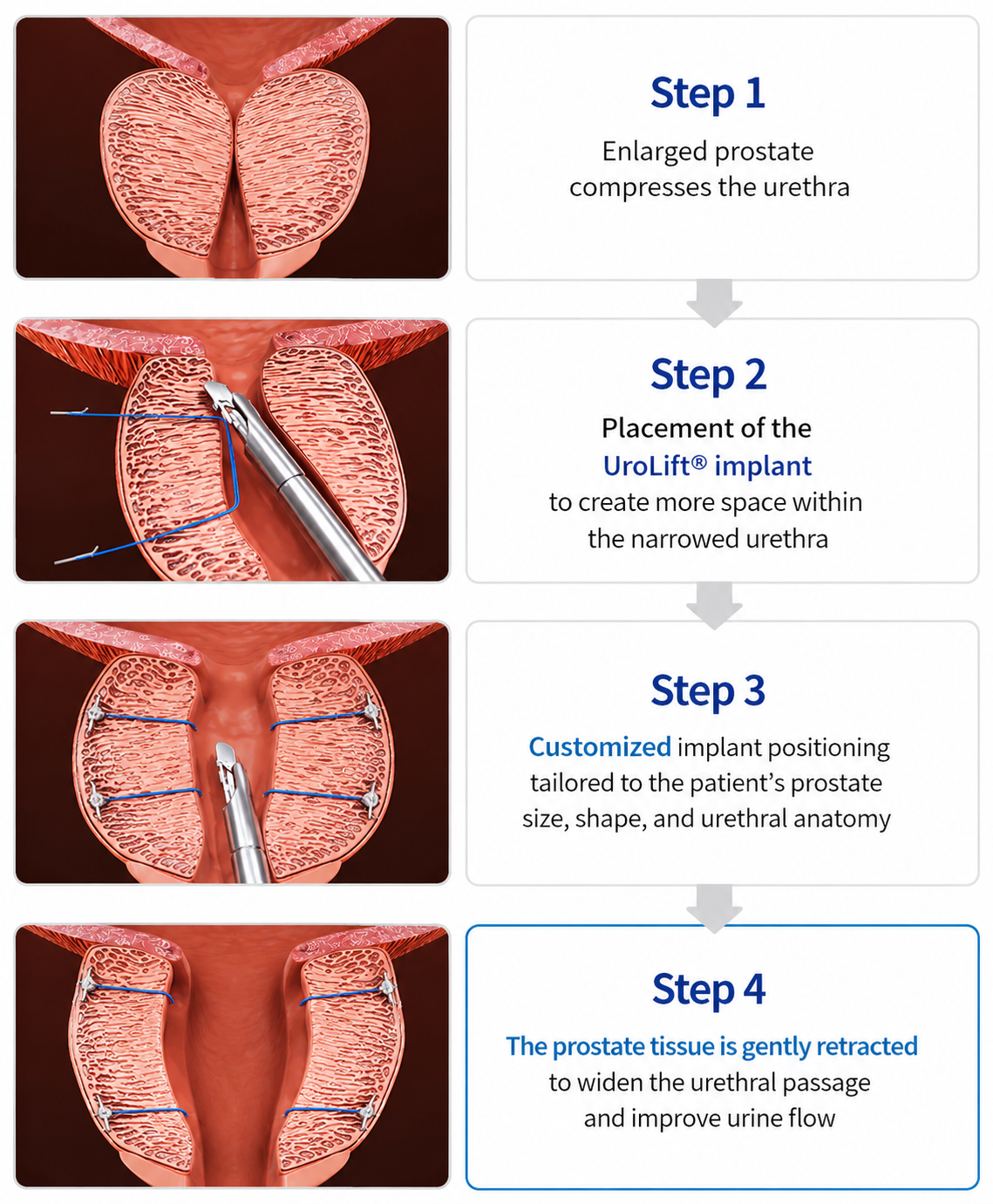
The Progator Procedure — 4 Steps

The Progator procedure is performed cystoscopically (through the urethra) under local anaesthesia in four sequential steps. Total procedure time is 15-30 minutes. Same-day discharge.

Progator Step 1 - local anaesthesia of enlarged prostate
STEP 01
Local Anaesthesia of Prostate

Local anaesthetic is applied directly to the enlarged prostate compressing the urethra — no general anaesthesia required.

Progator Step 2 - implant insertion to create urethral space
STEP 02
Implant Insertion

Small implants are inserted to create open space in the compressed urethra, reversing the obstruction caused by the enlarged prostate.

Progator Step 3 - individualised ligation based on anatomy
STEP 03
Individualised Ligation

The ligation technique is tailored to each patient based on prostate size, shape, urethral length, and other anatomical factors.

Progator Step 4 - final urethral space secured
STEP 04 · RESULT
Urethral Space Secured

The enlarged prostate is ligated (tied back), permanently securing the urethral channel and restoring normal urine flow.

The entire procedure is performed through the urethra — no incisions on the skin, no stitches, no catheter required for most patients. Patients walk out of the clinic 1-2 hours after the procedure ends.

Why Choose Progator

3 Core Advantages of Progator

01
Sexual Function Preserved

Because no tissue is cut or destroyed, the anatomical structures critical to ejaculation and erection remain intact. Clinical evidence shows 99% preservation of antegrade ejaculation — compared to only 25-50% with TURP. Many patients resume sexual activity within 1 week.

02
Fast Recovery & No Catheter

Most patients return to normal activity within 1-2 days — the fastest recovery of any BPH procedure. No urinary catheter required for most cases (compared to 3-5 days with TURP). Return to work the next day. Mild discomfort for 3-5 days only.

03
Local Anaesthesia Only

Performed under local anaesthesia — no general anaesthesia required. This makes Progator accessible to elderly patients, those with cardiac or pulmonary disease, and patients who cannot tolerate or prefer to avoid general anaesthesia. Essentially painless throughout the procedure.

Treatment Comparison

Progator vs Other BPH Treatments

Understanding how Progator compares to other BPH options helps you make an informed choice with your urologist. Each treatment has its place — Progator's unique value is minimising invasiveness while preserving sexual function.

Aspect
Medication
Progator
TURP
Invasiveness
None (oral pills)
Minimal (implants only)
Surgical (tissue removed)
Anaesthesia
None
Local only
Spinal or general
Procedure time
N/A
15–30 min
60–90 min
Recovery time
N/A (ongoing)
1–2 days
3–6 weeks
Catheter needed
No
Usually no
Yes, 3–5 days
Tissue removed
No
No
Yes (significant)
Ejaculation preserved
Yes (except tamsulosin)
~99%
~25–50%
Erectile function
Preserved
Preserved
Minor risk
Durability
Ongoing pills
5+ years
10+ years
Effective for large prostate (>80mL)
Limited
Not ideal
Yes

When Progator is the optimal choice: moderate BPH (IPSS 8-20), prostate 30-80mL with lateral lobe dominance, sexually active men concerned about ejaculatory preservation, patients wishing to discontinue long-term medication, poor candidates for general anaesthesia, and those wanting the shortest possible recovery time.

Clinical Quality System

Urogyn's 7-Point Care Standard

01
Cystoscopic Pre-Assessment

Direct visualisation of prostate anatomy to confirm Progator suitability before scheduling the procedure.

02
Individualised Implant Planning

Number, position, and depth of each implant calculated based on your specific prostate dimensions and symmetry.

03
Local Anaesthesia Only

No general anaesthesia required — accessible to elderly and medically complex patients with excellent safety.

04
Sexual Function Preservation

Anatomical landmark protection throughout — verumontanum, ejaculatory ducts, and neurovascular bundles preserved.

05
Sterile Cystoscopic Protocol

Surgical-grade sterility with single-use cystoscope sheaths and prophylactic antibiotic cover.

06
Same-Day Discharge

Walk-out within 1-2 hours of procedure end. Return to work the next day for most patients.

07
Structured Follow-Up

1 week, 4 weeks, and 12 weeks post-procedure review with IPSS reassessment at each visit.

+
International Patient Support

English-language records, aftercare video, and WhatsApp follow-up available after you return home.

Suitability

Is Progator Right for You?

✓ Ideal Progator Candidates

  • Moderate BPH with IPSS 8-20 and bothersome LUTS symptoms
  • Prostate volume 30-80mL with predominantly lateral lobe enlargement
  • Sexually active men prioritising ejaculation preservation
  • Patients wishing to discontinue long-term BPH medication
  • Poor candidates for general anaesthesia (cardiac, pulmonary, elderly)
  • Men needing the fastest possible recovery (back to work within 1-2 days)
  • International patients seeking minimally invasive specialist treatment

⚠ Not Ideal Candidates — Consider TURP/Rezum

  • Prostate volume over 80mL (Progator less effective at large volumes)
  • Significant median lobe enlargement (requires different approach)
  • Acute urinary retention currently requiring catheterisation
  • Active urinary tract infection (must resolve first)
  • Known prostate cancer or indeterminate elevated PSA (workup required first)
  • Previous prostate surgery causing anatomical distortion
  • Severe bleeding disorders without clearance
FAQ

Frequently Asked Questions

Common questions from international patients considering Progator prostate ligation in Busan, Korea.

What is Progator prostate ligation?
Progator is a minimally invasive prostate ligation procedure for BPH (enlarged prostate). Unlike traditional TURP surgery which removes prostate tissue, Progator uses small permanent implants to physically retract the enlarged prostate lobes, opening the compressed urethral channel. No cutting, no tissue removal, no thermal energy. The prostate remains intact but is mechanically "held open" by the implants. This approach preserves sexual function and requires minimal recovery.
How is Progator different from TURP or Rezum?
Three key differences: (1) TURP surgically removes prostate tissue through electrocautery — effective but invasive, with 3-6 week recovery and sexual function risks; (2) Rezum uses heated water vapour to destroy prostate tissue — moderately invasive, 2-3 week recovery; (3) Progator uses mechanical implants only — no tissue is cut, removed, or destroyed. Progator has the shortest recovery (1-2 days) and best preservation of ejaculatory and erectile function, but works best for moderate prostate sizes (30-80mL) without significant median lobe enlargement.
Does Progator preserve sexual function?
Yes — this is one of Progator's major advantages. Because no tissue is cut, removed, or destroyed, the anatomical structures critical to ejaculation (verumontanum, ejaculatory ducts) and the neurovascular bundles responsible for erection are not disturbed. Clinical evidence shows Progator preserves antegrade ejaculation in approximately 99% of patients — dramatically better than TURP (50-75% rate of retrograde ejaculation) or even Rezum. This makes Progator especially suitable for sexually active men concerned about these side effects.
How long does the procedure take and what is the recovery?
The procedure itself takes 15-30 minutes under local anaesthesia. Same-day discharge. Many patients walk out within 1-2 hours of the procedure ending. Recovery is the shortest of all BPH procedures — mild urinary discomfort for 3-5 days, normal activity resumed within 1-2 days, return to work the next day for most patients. Symptom improvement is noticeable within 2 weeks, with maximum benefit at 4-6 weeks. Sexual activity can typically resume within 1 week.
How long do Progator results last?
Clinical studies of prostatic urethral lift devices (the category Progator belongs to) show durable 5+ year results in the majority of patients. The implants are permanent and do not degrade. However, because the prostate can continue to grow with age, some patients may require additional implants or transition to other treatment after 5-10 years. For younger patients with significant prostate enlargement, this should be discussed with the urologist as part of long-term planning.
Who is a good candidate for Progator?
Best candidates: men with moderate BPH (IPSS 8-20), prostate volume 30-80mL, lateral lobe-dominant enlargement without large median lobe, active sexual life wishing to preserve ejaculation, concerns about medication side effects or wishing to stop long-term pills, and medically unsuitable for general anaesthesia. Poor candidates: prostate volume over 80mL, significant median lobe obstruction, severe urinary retention requiring catheter, or active urinary infection. Assessment requires cystoscopy and ultrasound to confirm anatomy suitability.
Is Progator done under general anaesthesia?
No — Progator is performed under local anaesthesia only, making it accessible to patients who cannot tolerate general anaesthesia (cardiac disease, pulmonary issues, elderly patients). Local anaesthetic is applied directly to the prostate via the cystoscopic approach, making the procedure essentially painless. Some patients opt for light IV sedation for relaxation, but this is optional rather than required. This anaesthetic simplicity is another key advantage over TURP.
How much does Progator cost in Busan?
As an elective BPH procedure, Progator is provided as a self-pay (비급여) service for international patients. Cost depends primarily on the number of implants required (typically 4-6 implants per procedure). Combined pricing includes consultation, cystoscopic assessment, the procedure itself, implants, and follow-up visits. Contact us via WhatsApp with your BPH details (IPSS score, prostate volume if known) for an accurate estimate.

Book Your Progator
Consultation — English OK

Board-certified urologist in Seomyeon, Busan. 15-30 min procedure. Local anaesthesia. Return to work the next day. Preserve sexual function.

📍 Seomyeon, Busanjin-gu, Busan 🚇 Seomyeon Station Exit 5 — 5 min walk 🔒 Strictly Confidential 🌐 English · 한국어