Prostatitis Treatment Seomyeon Busan | Chronic Prostate Inflammation | Urogyn
📍

Seomyeon, Busan

5 min · Seomyeon Station Exit 5

🩺

Board-Certified Urologist

Korean Prostate Society

🌐

English Consultations

International Patients Welcome

🔬

7-Test Diagnostic Battery

Comprehensive Workup

Urogyn Men's Clinic · Seomyeon, Busan

Prostatitis
Treatment
in Seomyeon, Busan

📍 Seomyeon, Busanjin-gu, Busan  |  🚇 Seomyeon Station Exit 5  |  🌐 English OK  |  🔬 Evidence-Based Care

Comprehensive prostatitis (전립선염) treatment at Urogyn Men's Clinic in Seomyeon, Busan — 7-test diagnostic battery to identify the specific prostatitis type followed by individualised treatment combining physical therapy, targeted medication, and symptomatic care. Board-certified urologist experienced in acute bacterial, chronic bacterial, CPPS (chronic pelvic pain syndrome), and asymptomatic inflammatory prostatitis. English consultations.

Quick Answer

Prostatitis treatment at Urogyn Seomyeon, Busan — comprehensive 7-test diagnostic workup distinguishes bacterial vs non-bacterial causes. Treatment combines 3 modalities: physical therapy (pelvic floor + thermotherapy), targeted medication (antibiotics, alpha-blockers, anti-inflammatories), and symptomatic care. English OK.

At a Glance
Location Seomyeon, Busan
Diagnostic tests 7 tests
Treatment 3 modalities
Categories NIH I–IV
Acute relief 1–2 weeks
Chronic/CPPS 3–12 months
Language English OK
Book via WhatsApp

Confidential · International patients welcome

About the Condition

What Is Prostatitis?

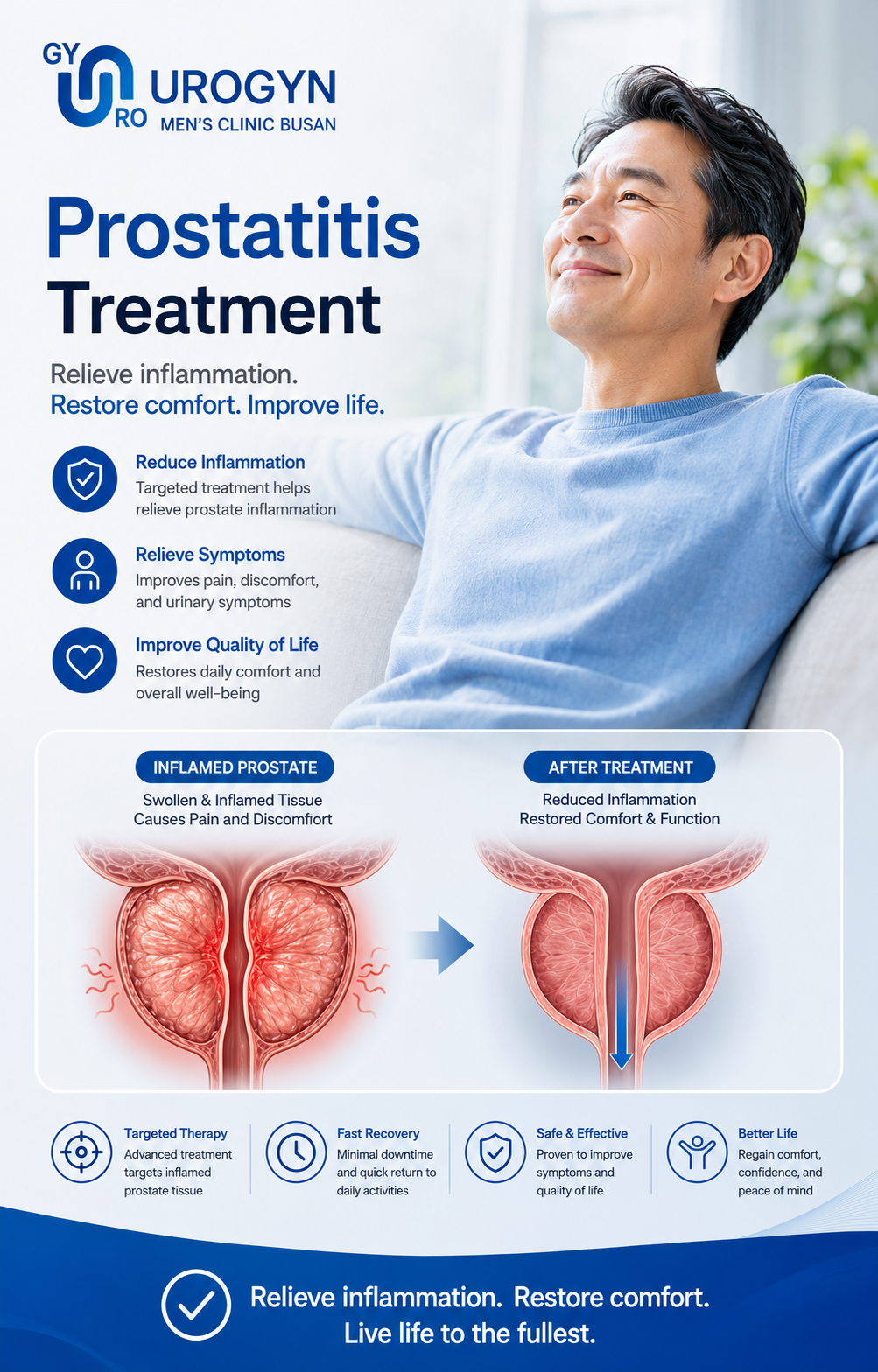
Prostatitis anatomy: normal prostate vs inflamed prostate with narrowed urethra

Normal prostate (left) vs inflamed prostate (right) — inflammation narrows the urethral passage and causes pelvic pain.

Prostatitis (전립선염) is inflammation of the prostate gland — a common urological condition affecting men of all ages, unlike BPH which is primarily age-related. Unlike BPH which produces obstructive urinary symptoms without pain, prostatitis characteristically causes pelvic, genital, perineal, or lower back pain, combined with urinary and sometimes sexual symptoms. Approximately 10-15% of men will experience prostatitis symptoms at some point in their lives, making it one of the most common reasons for urology consultation in men under 50.

Prostatitis is not a single disease but a group of conditions with distinct causes, symptoms, and treatments. The National Institutes of Health (NIH) classification defines four categories based on the underlying pathology. Accurate categorisation is essential because treatment differs fundamentally — bacterial prostatitis requires targeted antibiotics, while the most common form (CPPS / chronic pelvic pain syndrome) is primarily non-infectious and responds to a very different treatment approach. Misdiagnosis leads to ineffective repeated antibiotic courses and prolonged patient suffering — a common pattern we see in revision cases.

Common Prostatitis Symptoms

Pelvic Pain

Discomfort in pelvis, perineum (between genitals and anus), or lower abdomen.

Painful Urination

Burning or stinging sensation during or after urination (dysuria).

Urinary Frequency

Needing to urinate more often than usual, especially at night.

Urinary Urgency

Sudden strong urge to urinate that is difficult to defer.

Painful Ejaculation

Discomfort or pain during or immediately after ejaculation.

Erection Difficulty

Reduced erectile function or libido, often improving with treatment.

Lower Back Pain

Aching in lower back or hip region, often worsening with prolonged sitting.

Fatigue & Malaise

General feeling of unwellness, especially with acute bacterial infection.

NIH Classification — 4 Types of Prostatitis

Accurate categorisation determines treatment. At consultation, the urologist uses history, symptoms, and diagnostic testing to identify your specific category.

I
Acute Bacterial Prostatitis

Sudden severe bacterial infection with fever, chills, pelvic pain, and sometimes urinary retention. Uncommon but medical emergency — requires immediate antibiotic treatment and occasionally hospitalisation.

II
Chronic Bacterial Prostatitis

Recurrent UTIs caused by same organism residing in the prostate. Requires 6-12 weeks of culture-guided antibiotics able to penetrate prostate tissue (fluoroquinolones, Bactrim).

III
CPPS (Most Common — 90%+)

Chronic Prostatitis / Chronic Pelvic Pain Syndrome — chronic pelvic pain without proven bacterial infection. Multifactorial causes require multimodal treatment. This is what most "chronic prostatitis" actually is.

IV
Asymptomatic Inflammatory

Inflammation detected incidentally during evaluation for other issues (infertility, elevated PSA, BPH workup) in patients without symptoms. Usually requires no specific treatment.

Diagnostic Workup

7-Test Diagnostic Battery

Accurate diagnosis is the foundation of effective prostatitis treatment. Urogyn Busan uses a systematic 7-test diagnostic battery to identify the specific prostatitis category and rule out mimicking conditions. This comprehensive approach prevents the common problem of repeated ineffective antibiotic courses for non-bacterial cases.

Medical history and symptom assessment
TEST 01
History & Symptom Questionnaire

Detailed medical history, symptom onset, pain location, urinary symptoms, sexual symptoms, and NIH-CPSI (Chronic Prostatitis Symptom Index) scoring.

Blood test with PSA and inflammatory markers
TEST 02
Blood Work & PSA

Complete blood count, inflammatory markers (CRP, ESR), PSA level (often elevated in acute prostatitis), basic metabolic panel.

Urine sample for analysis and culture
TEST 03
Urinalysis & Urine Culture

Standard urinalysis plus urine culture — identifies urinary tract infection, bacterial species, and antibiotic sensitivity profile.

Prostate ultrasound examination
TEST 04
Prostate Ultrasound

Transrectal or abdominal ultrasound to assess prostate size, detect abscesses, stones, or anatomical abnormalities contributing to symptoms.

Prostate-specific examination and EPS analysis
TEST 05
Prostate Exam & EPS

Digital rectal examination and, when indicated, expressed prostatic secretion (EPS) analysis — differentiates bacterial from inflammatory from non-inflammatory CPPS.

Cardiovascular and general health screening
TEST 06
Cardiovascular Screening

ECG and general health screening — important for patients starting long-course antibiotics or alpha-blockers, and to rule out referred pain from other conditions.

Pathology and microbiology analysis
TEST 07
Pathology Correlation

For advanced or atypical cases — specialised microbiology, molecular testing, or referral pathology to identify unusual pathogens or rule out prostate cancer.

The entire workup is completed in a single visit — international patients do not need multiple appointments to obtain a diagnosis. Results are reviewed with the patient in English, and a personalised treatment plan is initiated at the same visit.

Treatment Options

3 Treatment Modalities

Once the prostatitis category is identified, treatment combines one or more of three main modalities. Acute bacterial prostatitis is primarily treated with antibiotics. Chronic bacterial prostatitis requires prolonged targeted antibiotics plus supportive care. CPPS (the most common form) responds best to a multimodal approach combining all three modalities simultaneously.

Beluga thermal prostate physical therapy device
Modality 01
Physical Therapy
— 물리치료 (Thermal & Pelvic Floor)

Thermal therapy using the Beluga device delivers controlled heat to the prostate, improving blood flow, reducing inflammation, and relaxing pelvic floor muscle tension. Combined with pelvic floor physiotherapy and biofeedback for comprehensive non-medication treatment — especially effective for CPPS.

  • Beluga thermal prostate therapy device
  • Pelvic floor relaxation and biofeedback
  • Sessions: 2–3 per week for 4–8 weeks
  • Ideal for: CPPS, chronic pelvic pain
  • Drug-free treatment modality
Prostatitis medication - antibiotics alpha blockers anti-inflammatories
Modality 02
Targeted Medication
— 약물치료 (Drug Therapy)

Culture-guided antibiotics for bacterial types (fluoroquinolones, Bactrim — prostate-penetrating drugs), alpha-blockers for urinary symptoms, NSAIDs or anti-inflammatories for pain and inflammation, muscle relaxants for pelvic tension, and neuromodulators (amitriptyline, pregabalin) for neuropathic pelvic pain in selected CPPS cases.

  • Antibiotics: culture-guided, 4–12 weeks
  • Alpha-blockers: tamsulosin, silodosin
  • Anti-inflammatories: NSAIDs, COX-2
  • Neuromodulators: for chronic CPPS pain
  • Individualised per NIH category
Symptomatic care - warm sitz baths and lifestyle modification
Modality 03
Symptomatic Care
— 대증요법 (Supportive Therapy)

Warm sitz baths (15-20 minutes, 2-3 times daily) provide immediate symptomatic relief by relaxing pelvic muscles. Lifestyle modification includes hydration, avoiding prolonged sitting, dietary adjustments (limiting spicy foods, caffeine, alcohol), stress management, and regular gentle exercise. Often combined with the other modalities.

  • Warm sitz baths 15-20 min, 2-3x daily
  • Hydration 2-3L water daily
  • Diet: avoid spicy, caffeine, alcohol triggers
  • Activity: avoid prolonged sitting, cycling
  • Stress management and sleep hygiene

Treatment Matching by NIH Category

  • Category I (Acute Bacterial): immediate broad-spectrum IV/oral antibiotics, then culture-guided 4-6 week course. Supportive care for symptoms.
  • Category II (Chronic Bacterial): 6-12 weeks of culture-guided prostate-penetrating antibiotics (fluoroquinolones, Bactrim). Alpha-blocker for urinary symptoms.
  • Category III (CPPS): multimodal approach combining all three modalities — physical therapy + tailored medication + symptomatic care. 3-12 months expected treatment duration.
  • Category IV (Asymptomatic): usually no treatment needed; observation and counselling. Treatment only if PSA concerns or infertility.
Clinical Quality System

Urogyn's 7-Point Care Standard

01
Systematic Diagnosis

7-test diagnostic battery completed in a single visit — no empirical "try antibiotics and see" approach.

02
NIH-CPSI Scoring

Validated symptom index tracks response objectively over time, preventing subjective treatment drift.

03
Culture-Guided Antibiotics

Bacterial cases receive culture-based antibiotic selection, not empirical broad-spectrum use that drives resistance.

04
Multimodal CPPS Approach

CPPS patients receive physical therapy + medication + symptomatic care together — not single-modality failures.

05
Beluga Thermal Therapy

Advanced thermal prostate therapy device complements pharmacotherapy for stubborn CPPS cases.

06
Lifestyle Integration

Dietary, activity, and stress management coaching integrated into every treatment plan — addressing root lifestyle triggers.

07
Structured Follow-Up

Regular follow-up every 4-6 weeks with NIH-CPSI reassessment. Treatment adjustment based on measurable response.

+
International Patient Support

English records, prescription refill management, and WhatsApp follow-up available after you return home.

Suitability

When to See a Urologist for Prostatitis

✓ See a Specialist Urologist

  • Chronic pelvic pain lasting more than 3 months despite general practitioner treatment
  • Recurrent UTIs with the same bacterial organism
  • Painful ejaculation or reduced sexual function with urinary symptoms
  • Previous antibiotic courses failed to resolve symptoms (probable CPPS)
  • Fever with severe pelvic pain (may be acute bacterial — seek urgent care)
  • Elevated PSA together with pelvic pain symptoms
  • International patients seeking comprehensive English-language workup

⚠ Urgent / Emergency Situations

  • High fever (over 38.5°C) with severe pelvic pain — possible acute bacterial prostatitis
  • Inability to urinate (acute urinary retention) — requires immediate catheterisation
  • Blood in urine or semen without explanation — requires prompt workup
  • Severe pain unresponsive to standard analgesics
  • Symptoms of sepsis (chills, confusion, rapid pulse) — emergency department
  • Patients on immunosuppression or with diabetes developing acute symptoms
FAQ

Frequently Asked Questions

Common questions from international patients considering prostatitis treatment in Busan, Korea.

What is prostatitis and how is it different from BPH?
Prostatitis is inflammation of the prostate gland — it can occur at any age, unlike BPH (benign prostatic hyperplasia) which is age-related enlargement. Prostatitis typically causes pain (pelvic, genital, perineal, lower back), urinary symptoms (frequency, urgency, burning), and sometimes sexual symptoms (painful ejaculation, reduced libido). BPH primarily causes obstructive urinary symptoms without pain. The two conditions have different causes, diagnostic workup, and treatments — though occasionally both can coexist.
What are the 4 types of prostatitis?
NIH classification defines four types: (I) Acute Bacterial Prostatitis — sudden severe infection with fever and urinary retention, requires immediate antibiotic treatment; (II) Chronic Bacterial Prostatitis — recurrent UTIs with same organism, treated with long-course antibiotics; (III) Chronic Prostatitis / Chronic Pelvic Pain Syndrome (CPPS) — the most common form (90%+ of cases), characterised by chronic pelvic pain without proven infection; (IV) Asymptomatic Inflammatory Prostatitis — incidental finding during evaluation for other issues. Categories III and IV are most common in specialist urology practice.
What causes chronic prostatitis (CPPS)?
Chronic prostatitis / CPPS has multiple overlapping causes rather than a single infectious agent: (1) Pelvic floor muscle dysfunction — chronic tension in pelvic muscles causing referred pain; (2) Neurogenic inflammation — abnormal nerve signalling in pelvic region; (3) Autoimmune inflammation — inflammatory response without bacteria; (4) Previous unresolved infection leaving chronic inflammation; (5) Psychosocial factors — stress, anxiety amplifying pain perception; (6) Lifestyle factors — prolonged sitting, cycling, dehydration, alcohol. Effective treatment typically addresses multiple causes simultaneously.
What tests diagnose prostatitis?
Urogyn Busan uses a 7-test diagnostic battery: (1) Detailed medical history and symptom questionnaire; (2) Blood work including PSA and inflammatory markers; (3) Urinalysis and urine culture; (4) Prostate ultrasound (transrectal or abdominal); (5) Prostate-specific examination and expressed prostatic secretion (EPS) analysis; (6) Cardiovascular and general health screening to rule out contributing conditions; (7) Pathology correlation for advanced cases. This systematic approach distinguishes bacterial from non-bacterial causes and identifies coexisting conditions mimicking prostatitis.
How is prostatitis treated?
Treatment depends on the category. For bacterial prostatitis (types I and II), targeted antibiotics based on culture — acute cases receive 4-6 weeks, chronic bacterial 6-12 weeks of culture-guided therapy. For CPPS (type III), a multimodal approach is used combining: (1) Physical therapy — pelvic floor exercises, biofeedback, thermal therapy; (2) Medication — alpha-blockers, anti-inflammatories, muscle relaxants, neuromodulators when needed; (3) Symptomatic care — warm sitz baths, lifestyle modification, stress management. Treatment often continues for months with gradual improvement.
How long does prostatitis take to heal?
Timeline varies significantly by type. Acute bacterial: symptoms resolve within 1-2 weeks with antibiotics, though full recovery takes 4-6 weeks. Chronic bacterial: improvement over 6-12 weeks of culture-guided antibiotics. CPPS: gradual improvement over 3-12 months is typical, with multimodal therapy. Some CPPS patients achieve complete symptom resolution; others experience significant improvement with occasional mild flares that can be managed with lifestyle adjustments. Early and systematic treatment improves outcomes.
Can prostatitis affect fertility or sexual function?
Yes, prostatitis can impact sexual and reproductive function. Symptoms may include painful ejaculation, reduced libido, erectile difficulty, and in some cases altered semen parameters (affecting fertility). These effects are typically reversible with effective treatment. For men actively trying to conceive, fertility assessment including semen analysis should be considered as part of the workup. Most sexual function symptoms improve substantially as the underlying inflammation resolves.
How much does prostatitis treatment cost in Busan?
For international patients, prostatitis treatment is provided as a self-pay (비급여) service. Initial comprehensive diagnostic workup (7 tests) has a set consultation price. Treatment cost varies by chosen modality — medication-only approaches are most affordable, while multimodal treatment including physical therapy sessions is higher. Follow-up visits are priced per visit. Contact us via WhatsApp with your symptoms and prior diagnostic results (if available) for an accurate estimate.

Book Your Prostatitis
Diagnosis & Treatment Today

Board-certified urologist in Seomyeon, Busan. 7-test diagnostic battery. Multimodal treatment. English OK.

📍 Seomyeon, Busanjin-gu, Busan 🚇 Seomyeon Station Exit 5 — 5 min walk 🔒 Strictly Confidential 🌐 English · 한국어