


Men's STI & STD
Testing & Treatment
in Seomyeon, Busan
📍 Seomyeon, Busanjin-gu, Busan | 🚇 Seomyeon Station Exit 5 | 🌐 English OK | 🔒 Confidential
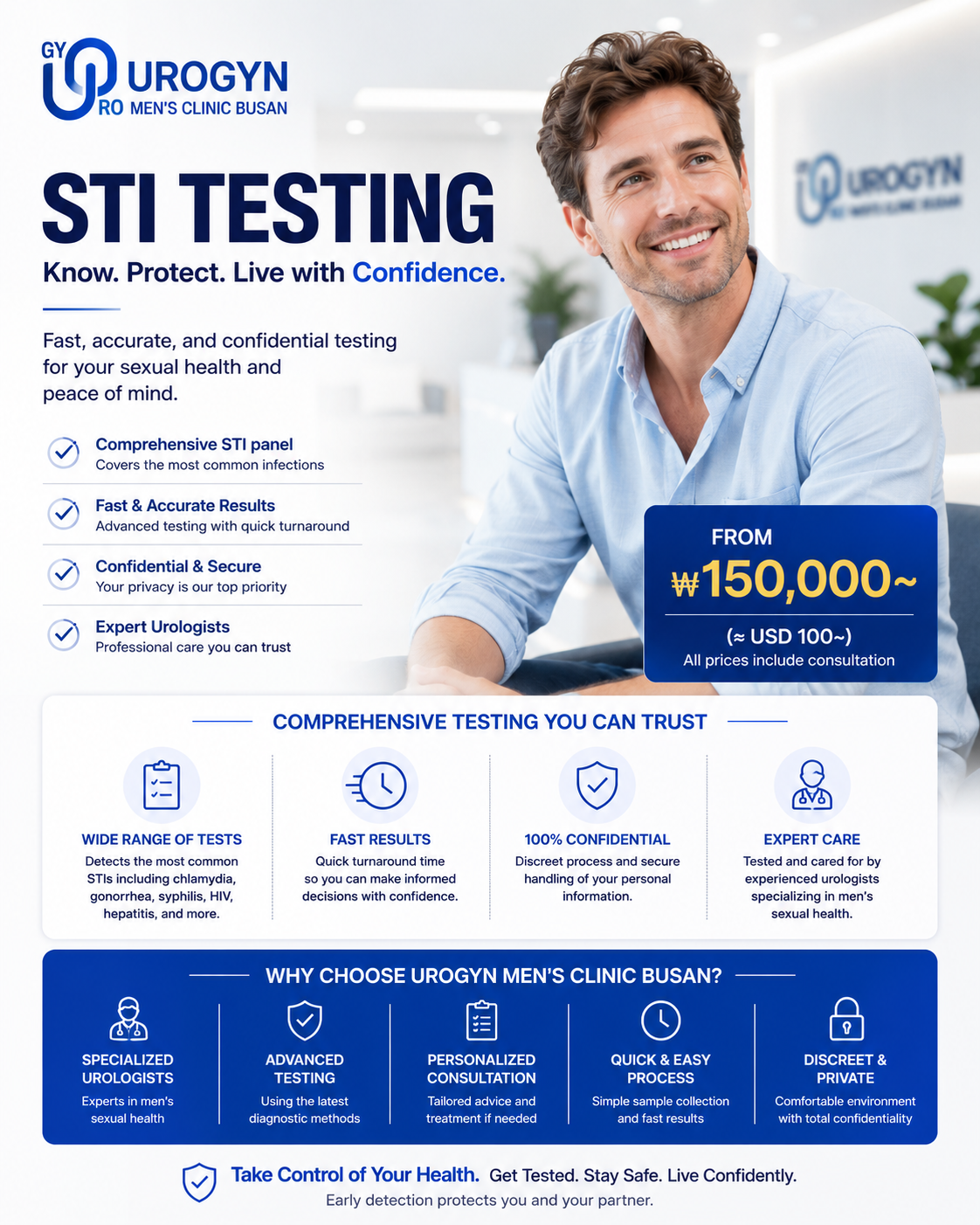
Comprehensive men's sexually transmitted infection (성병) testing and treatment at Urogyn Men's Clinic in Seomyeon, Busan. Coverage for 12 major STIs including gonorrhea, chlamydia, HPV, syphilis, herpes, HIV, trichomoniasis, and mycoplasma. 4 diagnostic methods — physical exam, brush sample, blood test, and high-accuracy PCR. Board-certified urologist. Strictly confidential no-judgment care. English consultations.
STI testing at Urogyn Seomyeon, Busan — 12 STIs covered: gonorrhea, chlamydia, HPV, syphilis, candida, trichomoniasis, ureaplasma, herpes, HIV, mycoplasma genitalium & hominis. 4 diagnostic methods: physical exam, brush, blood, PCR. Board-certified urologist. Strictly confidential. English OK.
No-judgment · Confidential · International patients welcome
Men's STIs — Why Testing Matters
Sexually transmitted infections (STIs / 성병) are infections caused by bacteria, viruses, fungi, or parasites transmitted primarily through sexual contact. They are extremely common globally — the WHO estimates more than 1 million new STI cases occur every day worldwide. Despite this prevalence, many men delay testing due to embarrassment, stigma, or false reassurance from the absence of symptoms.
The most important thing to know: many STIs, especially in men, can be completely asymptomatic. You may have an infection without noticing any signs, yet still transmit it to partners and develop long-term complications. Routine testing is the only reliable way to know your status — and with modern diagnostic methods (particularly PCR) and effective treatments, most STIs are fully curable if detected early.
When to Get Tested
- Any symptoms present — urethral discharge, burning urination, genital lesions, rashes, swelling, itching
- New sexual partner — especially within the last 3 months
- Multiple recent partners — baseline screening is recommended
- Unprotected intercourse with unknown-status partner
- Partner diagnosed with an STI — partner notification testing required
- Routine annual screening for all sexually active men
- Before starting a new relationship — peace of mind for both partners
- After travel with potential sexual contact in different regions
Comprehensive Coverage of 12 Major STIs
Urogyn Busan provides testing and treatment for twelve major sexually transmitted infections grouped by cause — bacterial (most common, curable), viral (require chronic management), fungal, and parasitic. Each has different symptoms, incubation periods, and treatment protocols.
Gonorrhea
— 임질 (Gonorrhea)One of the most common bacterial STIs. Caused by Neisseria gonorrhoeae. May be asymptomatic in men or cause significant urethral discharge.
Chlamydia
— 클라미디아 (Chlamydia)Caused by Chlamydia trachomatis. Very frequently asymptomatic — often called the "silent" STI. Detected mainly through screening.
Genital Warts / HPV
— 곤지름 / 사마귀 (HPV)Caused by human papillomavirus (HPV). Can lead to visible genital warts. Some HPV types carry cancer risk if persistent.
Syphilis
— 매독 (Syphilis)Caused by Treponema pallidum. Progresses through stages over years if untreated. Skin lesions, systemic symptoms, eventually neurological damage.
Candidiasis
— 칸디다증 (Yeast)Fungal infection caused by Candida albicans. May or may not be sexually transmitted — commonly arises from overgrowth in warm, moist conditions.
Trichomoniasis
— 트리코모나스 (Trich)Caused by Trichomonas vaginalis, a single-cell parasite. Men frequently asymptomatic but transmit to partners who develop symptoms.
Ureaplasma
— 유레아플라즈마 (Ureaplasma)Common commensal bacteria that can cause urethritis when overgrown. Pathogenic role debated but treatment often resolves symptoms.
Herpes
— 헤르페스 (HSV)Caused by herpes simplex virus (HSV-1 or HSV-2). Typically first outbreak 1-2 weeks after contact; recurrent episodes lifelong but less severe.
HIV / AIDS
— 에이즈 (HIV)Human immunodeficiency virus. Transmitted through sexual contact, blood contact, and mother-to-child. NOT transmitted through casual contact like handshakes or sharing utensils.
Mycoplasma Genitalium
— 마이코플라즈마 제니탈륨One of the causative pathogens of non-gonococcal urethritis. Often transmitted with or mistaken for chlamydia.
Mycoplasma Hominis
— 마이코플라즈마 호미니스Smaller Mycoplasma species. Sometimes found with other infections. In women can reach upper genital tract causing complications.
Non-Specific Urethritis
— 비임균성 요도염 (NSU)Urethritis not caused by gonorrhea — can be from chlamydia, mycoplasma, ureaplasma, trichomonas, or other organisms. Requires multi-pathogen testing to identify.
4 Diagnostic Methods at Urogyn Busan
Different STIs require different diagnostic approaches. Urogyn Busan uses four complementary methods — often combined for comprehensive screening. Each method has specific strengths: physical exam for visible lesions, brush sampling for skin-based infections, blood test for viruses and antibodies, and PCR for high-accuracy molecular detection of multiple pathogens.
Physical Examination
Visual inspection and palpation for visible lesions, rashes, warts, swelling, or discharge. First-line evaluation for all symptomatic patients. Identifies skin-level infections like genital warts, herpes blisters, and candida.
Brush Sample Test
Gentle sample collection from visible skin lesions using a soft brush. Cells are examined for viruses or fungi. Particularly useful for HPV typing — distinguishes low-risk wart types from high-risk cancer-associated types.
Blood Test
Small blood draw detects antibodies and antigens for systemic infections: HIV (antibody/antigen combo), syphilis (RPR/TPHA), hepatitis B and C. Essential for diagnosing infections with window periods requiring seroconversion.
PCR Test
Molecular detection of pathogen DNA from urine or urethral swab — the gold standard for many STIs. High accuracy (99%+) enables early detection before symptoms appear. Detects gonorrhea, chlamydia, mycoplasma, ureaplasma, trichomonas in a single multi-target panel.
Risks of Leaving STIs Untreated
Understanding the specific infection pathogen is essential for appropriate treatment. Leaving any STI untreated, delayed, or under-treated can cause permanent complications. Early treatment within approximately 2 weeks of symptom onset typically produces the best outcomes with the least complications.
⚠ Critical Potential Complications of Untreated STIs
Infertility
Scarring of the reproductive tract from chronic inflammation — irreversible in advanced cases
Chronic Urethritis
Persistent burning, discharge, and discomfort resistant to later treatment
Epididymitis & Orchitis
Painful inflammation of the epididymis and testicle — may affect fertility
Chronic Prostatitis
Long-term pelvic pain, urinary dysfunction, and sexual dysfunction
Cancer Risk (HPV)
High-risk HPV types can cause penile and anal cancers if persistent for years
Systemic Damage (Syphilis)
Untreated syphilis progresses to cardiovascular and neurological damage
Partner Transmission
Silent asymptomatic infections continue spreading to partners, causing their complications
HIV Progression
Untreated HIV progresses to AIDS; early ART prevents progression with excellent outcomes
The good news: most bacterial STIs are fully curable with appropriate antibiotics when diagnosed promptly. Even viral STIs like herpes and HIV are effectively managed with modern antivirals. The key is early detection — which requires routine testing for sexually active men and prompt evaluation of any symptoms.
Urogyn's 7-Point Care Standard
12 STIs Covered
Comprehensive testing panel for all major STIs — no need to visit multiple clinics.
4 Diagnostic Methods
Physical exam, brush sample, blood test, and PCR combined for complete coverage.
High-Accuracy PCR
99%+ accuracy molecular detection — can identify infection before symptoms develop.
Multi-Target Panel
Single PCR run detects 5+ bacterial/parasitic STIs — efficient and cost-effective.
In-House Treatment
All STI treatments delivered in-clinic — no external referrals, no delays.
Strict Confidentiality
Isolated records, private consultation rooms, 1:1 care — zero cross-department exposure.
Partner Notification Support
Discreet guidance on partner notification — essential to prevent reinfection and spread.
International Patient Support
English-language test results & treatment records. WhatsApp follow-up after return home.
Who Should Get Tested?
✓ Should Get Tested
- Any urethral discharge, burning urination, genital lesions, rashes, or swelling
- New sexual partner (especially within last 3 months)
- Multiple recent sexual partners — baseline screening recommended
- Unprotected intercourse with partner of unknown status
- Partner diagnosed with any STI — partner notification testing required
- Routine annual screening for all sexually active men
- Before starting a new committed relationship — peace of mind for both
- After travel involving sexual contact in different regions
⚠ Important Considerations
- Incubation/window period awareness — test timing matters for accuracy
- HIV requires 8-10 week window before reliable testing
- Syphilis requires approximately 3-6 weeks for reliable blood test
- Some tests need repeat if performed too early — urologist advises timing
- Continue using protection until test results confirmed negative
- Partner testing is essential — reinfection common without partner treatment
Frequently Asked Questions
Common questions from international patients considering STI testing & treatment in Busan, Korea.
What STIs does Urogyn Busan test for?
How are STIs diagnosed?
When should I get tested for STIs?
Is STI testing at Urogyn Busan confidential?
How soon do STI symptoms appear?
What happens if I leave an STI untreated?
Are most STIs curable?
Do I need to bring my partner?
Book Your Confidential
STI Testing Today — English OK
Board-certified urologist in Seomyeon, Busan. 12 STIs covered. High-accuracy PCR testing. Strictly confidential. No judgment.
