Testicular Prosthesis Surgery Seomyeon Busan | Artificial Testicle Implant | Urogyn
📍

Seomyeon, Busan

5 min · Seomyeon Station Exit 5

🩺

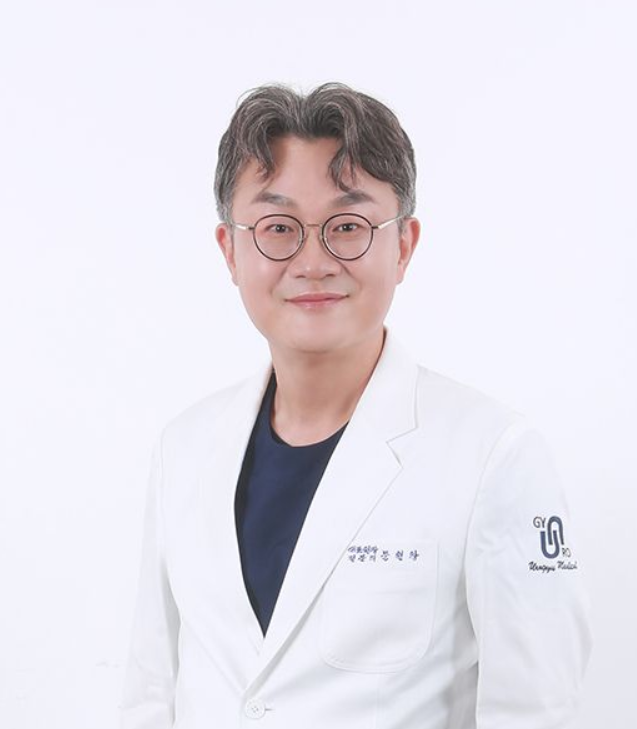
Board-Certified Urologist

Specialist Men's Clinic

30–40 min Procedure

Local Anaesthesia · Same-Day

KFDA / FDA Approved

Medical-Grade Implants

Urogyn Men's Clinic · Seomyeon, Busan

Testicular Prosthesis
Implant Surgery
in Seomyeon, Busan

📍 Seomyeon, Busanjin-gu, Busan  |  🚇 Seomyeon Station Exit 5  |  🌐 English OK  |  🔒 Confidential

Testicular prosthesis surgery (인공고환 수술) at Urogyn Men's Clinic in Seomyeon, Busan — restoration of natural scrotal appearance for men with congenital absence, testicular atrophy, or post-orchiectomy. Two KFDA/FDA-approved implant options: anatomical saline-filled prosthesis and silicone gel prosthesis, selected based on your preferences for weight, feel, and shape. 3-4cm incision, 30-40 minute procedure under local anaesthesia, same-day discharge. Board-certified urologist. English consultations.

Quick Answer

Testicular prosthesis at Urogyn Seomyeon, Busan2 implant options(anatomical saline & silicone gel), KFDA/FDA-approved. 3-4cm incision, 30-40 min procedure, local anaesthesia. Restores scrotal symmetry for congenital absence, atrophy, or post-orchiectomy. English OK.

At a Glance
Location Seomyeon, Busan
Implant options 2 types
Procedure 30–40 min
Incision 3–4 cm
Anaesthesia Local
Approval KFDA / FDA
Return to work 2–3 days
Language English OK
Book via WhatsApp

Confidential · International patients welcome

Part 1 · Understanding

What Is Testicular Prosthesis Surgery?

Testicular prosthesis surgery (인공고환 수술) — also known as testicular implant or artificial testicle surgery — is the surgical placement of a medical-grade implant into the scrotum to restore natural scrotal appearance for men missing one or both testicles. The procedure has been performed for over 60 years and is a well-established restorative surgery with high patient satisfaction rates worldwide.

The goal is aesthetic and psychological restoration — recreating the visual symmetry of the scrotum and relieving the body-image concerns that often accompany testicular absence. The implant replicates the size, shape, and general feel of a natural testicle within the scrotum. While the prosthesis does not produce testosterone, sperm, or have any hormonal or reproductive function, the restoration of normal appearance significantly improves quality of life, self-confidence, and intimate relationships for many men.

Who Considers Testicular Prosthesis Surgery?

Common Indications

You may be a candidate if you experience:

  • Congenital testicular absence — born without one or both testicles (agenesis or undescended testicle that could not be brought down surgically)
  • Testicular atrophy — permanent shrinkage from previous injury, severe mumps orchitis, vascular compromise, or hormonal issues
  • Post-orchiectomy status — after surgical removal due to testicular cancer, severe trauma, untreated torsion, or chronic testicular pain
  • Psychological impact from scrotal asymmetry — body-image concerns, relationship difficulties, or avoidance behaviour

3 Main Reasons Men Seek This Surgery

Part 2 · Patient Groups

Three Main Patient Groups

Men considering testicular prosthesis generally fall into three categories, each with specific considerations for surgical planning. Understanding which group you belong to helps the urologist tailor the approach — including size matching, surgical technique, and post-operative expectations.

01 Congenital
Congenital Absence

Born without one or both testicles, or with an undescended testicle that could not be surgically brought down. Often discovered in childhood or adolescence. The scrotum on the affected side may be underdeveloped. Surgical planning includes preparing the smaller scrotal pocket to receive the implant.

02 Acquired Atrophy
Testicular Atrophy

Permanent shrinkage of a previously normal testicle — from injury (trauma, sports injury), severe mumps or infection, vascular compromise (post-torsion), or hormonal dysfunction. The testicle may still be present but too small to provide normal appearance. Usually the atrophic testicle is removed and prosthesis placed in same session.

03 Post-Orchiectomy
After Surgical Removal

After a testicle has been surgically removed due to testicular cancer, severe trauma, untreated torsion, or chronic pain. Many cancer patients opt for immediate prosthesis placement at the time of orchiectomy; others return months or years later. Requires clearance from oncology team before elective prosthesis surgery.

⚠ Important to Understand

Testicular Prosthesis Is a Cosmetic Restoration Only

The implant does not produce testosterone, sperm, or have any reproductive or hormonal function. It restores only visual and tactile appearance. If you have one remaining natural testicle, it will generally compensate and keep testosterone in the normal range. If both testicles are absent or non-functional, separate testosterone replacement therapy (TRT) may be needed — this is discussed at consultation.

Part 3 · Implant Options

2 Prosthesis Options at Urogyn Busan

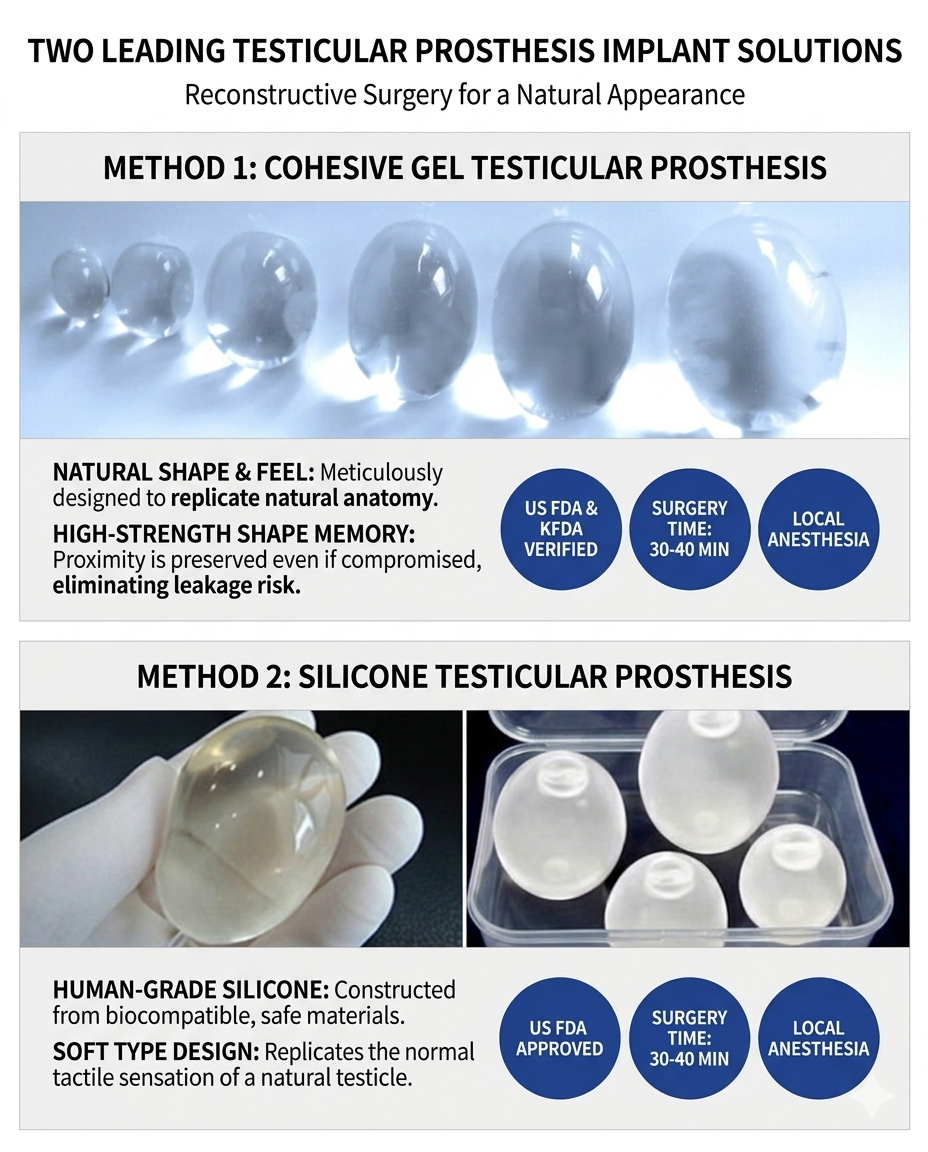
Urogyn Busan offers two medical-grade testicular prosthesis options, both with regulatory approval from KFDA (Korea) and/or US FDA. The choice depends on your preferences for weight, tactile feel, and anatomical shape — all three are discussed in detail at consultation where you can physically examine sample implants.

Silicone gel testicular prosthesis
Option 02 · Softer Texture
Silicone Gel Prosthesis
— 실리콘 인공고환 (Silicone Gel Implant)

A solid silicone gel prosthesis made from medical-grade silicone elastomer — the same category of material used in other long-established medical implants. Provides a softer tactile feel compared to saline-filled prostheses. Round or oval shape. FDA approved. A good option for patients who prioritise softness over anatomical shape precision or for specific anatomical situations where the urologist recommends this type.

Approval US FDA
Procedure 30–40 min
Anaesthesia Local
  • Material: medical-grade silicone gel
  • Feel: softer tactile sensation
  • Shape: round/oval (less anatomical)
  • Durability: robust, long-lasting material
  • Best for: patients prioritising softness

How the Right Size Is Selected

At consultation, the urologist measures the contralateral (opposite side) testicle using calipers — or for patients with bilateral absence, selects an appropriate size based on body habitus and patient preference. Available sizes range from small to extra-large, allowing precise matching for symmetric scrotal appearance. The selected prosthesis is ordered pre-operatively for your specific procedure. Urogyn does not operate without the correct size confirmed.

Clinical Quality System

Urogyn's 7-Point Care Standard

01
Pre-Op Size Matching

Caliper measurement of contralateral testicle ensures precise symmetric result — no guesswork.

02
KFDA / FDA Implants

Only regulatory-approved medical-grade prostheses — no off-brand or unregulated products.

03
2 Implant Options

Anatomical saline or silicone gel — selected based on your preferences for shape and feel.

04
Sterile Technique

Strict surgical sterility with prophylactic IV antibiotics — infection risk below 1%.

05
Scrotal Suture Fixation

Small suture secures prosthesis position, preventing displacement and drift.

06
Multi-Layer Closure

Meticulous layer-by-layer closure minimises scar visibility and optimises healing.

07
Structured Follow-Up

1-week and 4-week reviews monitor healing and prosthesis positioning.

+
International Patient Support

English aftercare instructions and WhatsApp follow-up after you return home.

Confidentiality & Candidates

Privacy & Suitability

Independent Consultation Room

Fully private rooms — comfortable discussion of sensitive concerns.

Separate Patient Records

Isolated records system. No cross-department data sharing.

1:1 Care System at Urogyn Busan
1:1 Care System

Dedicated staff from check-in to discharge. Zero exposure.

✓ Good Candidates

  • Men with congenital testicular absence (cryptorchidism, agenesis)
  • Men with testicular atrophy from previous injury, infection, or torsion
  • Post-orchiectomy patients — with oncology clearance if cancer-related
  • Men with psychological distress or relationship impact from scrotal asymmetry
  • Adequate scrotal skin elasticity and no active local infection
  • Realistic expectations about aesthetic-only restoration (not hormonal/reproductive)
  • International patients seeking specialist English-speaking urological care

⚠ Important Considerations

  • Active testicular cancer treatment ongoing — wait for oncology clearance
  • Active scrotal or groin infection — treat first before elective surgery
  • Bleeding disorders without medical clearance
  • Unrealistic expectations that prosthesis will restore hormonal or reproductive function
  • Severe contralateral scrotal skin scarring or deficiency — may need skin expansion first
  • Current anticoagulant therapy — requires perioperative management plan
FAQ

Frequently Asked Questions

Common questions from international patients considering testicular prosthesis surgery in Busan, Korea.

What is testicular prosthesis surgery?
Testicular prosthesis surgery (인공고환 수술) is the surgical placement of an artificial testicle into the scrotum to restore natural scrotal appearance for men missing one or both testicles. It is a restorative, not functional, procedure — the implant does not produce sperm or testosterone, but it restores the visual and tactile symmetry of the scrotum. Three main patient groups: men with congenital absence (born without a testicle), men with testicular atrophy from injury or infection, and men post-orchiectomy (surgical removal due to testicular cancer, trauma, or torsion).
Who is a good candidate for testicular prosthesis?
Good candidates include: (1) Men with congenital testicular absence (cryptorchidism that could not be brought down, or agenesis) noticed from childhood or adolescence; (2) Men with testicular atrophy from previous injury, severe mumps orchitis, vascular compromise, or hormonal issues; (3) Men post-orchiectomy — after surgical removal for testicular cancer, trauma, severe torsion, or chronic pain; (4) Men experiencing psychological distress, body-image issues, or relationship difficulties due to scrotal asymmetry; (5) Men with adequate scrotal skin elasticity and no active local infection. Consultation evaluates scrotum size, skin condition, and prosthesis fit.
What are the 2 prosthesis options at Urogyn Busan?
Two prosthesis types: (1) Anatomical saline-filled prosthesis — a saline-filled shell shaped to match natural testicular anatomy, with KFDA and US FDA approval. Offers natural weight and movement within the scrotum, and anatomical shape provides the most realistic appearance. (2) Silicone gel prosthesis — solid silicone gel implant, US FDA approved, provides a softer tactile feel. Each patient's preference (weight, feel, shape priority) and anatomy guide the selection. Both are placed through the same surgical approach. Size is matched to the contralateral testicle for symmetry.
How is the procedure performed?
Under local anaesthesia (with IV sedation if preferred), a 3-4cm incision is made at the upper scrotum or via an inguinal approach. A pocket is created within the scrotum to receive the implant. The appropriate size prosthesis — selected pre-operatively to match the contralateral testicle — is placed into the pocket and fixed with a small suture to prevent displacement. Multi-layer closure ensures proper healing. Total procedure time is 30-40 minutes. Same-day discharge. Patients walk out within 30 minutes of completion.
Does testicular prosthesis produce testosterone or sperm?
No — a testicular prosthesis is a purely cosmetic/aesthetic restoration. It does not produce testosterone, sperm, or have any hormonal or reproductive function. It restores only the visual and tactile appearance of the scrotum. If you have one remaining natural testicle, that testicle continues to produce testosterone and sperm normally and will generally compensate, keeping testosterone levels in the normal range. If both testicles are absent or non-functional, testosterone replacement therapy (TRT) may be needed separately — discussed at consultation.
Is the procedure painful?
The procedure itself is comfortable due to local anaesthesia — patients feel only mild pressure or pulling, not pain. Post-operative discomfort is typically mild-to-moderate for 2-3 days, well-managed with standard painkillers and an ice pack. Some scrotal swelling and bruising is normal and resolves over 2 weeks. Supportive underwear is recommended during recovery. Most patients are surprised that pain is less than expected, similar to the discomfort after a sports injury.
How long is recovery after testicular implant surgery?
Recovery timeline: ice pack application for first 48 hours to minimise swelling; return to desk work at 2-3 days; light physical activity at 1 week; full physical activity and exercise at 2-3 weeks; sexual activity after 4 weeks. Compression supportive underwear is worn continuously for 2 weeks to support the new prosthesis during healing. Follow-up visits at 1 week (suture check) and 4 weeks (final assessment). Scars typically fade significantly over 6 months.
How long does a testicular prosthesis last?
Modern testicular prostheses are designed for long-term permanent placement — typically 15-20 years or longer. Both saline and silicone gel implants are manufactured to medical-grade specifications with durable materials. Rare complications include prosthesis displacement (drift), infection, or shell rupture (rare with modern implants). If a complication occurs, revision or replacement surgery is possible. Most patients retain their prosthesis without problems for decades. Regular annual self-examination and routine follow-up ensure any issue is caught early.

Book Your Consultation
Today — English OK

Board-certified urologist in Seomyeon, Busan. KFDA/FDA-approved implants. 30-40 min procedure. Private & confidential.

📍 Seomyeon, Busanjin-gu, Busan 🚇 Seomyeon Station Exit 5 — 5 min walk 🔒 Strictly Confidential 🌐 English · 한국어